An experience in development testing
Disclaimer: I am writing this almost three years after the end of my experience in Crytek, and at the time I worked on several builds at once, many of which ended up never released. This means it’s possible some details might not be 100% accurate, although I tried to research as much as I could.
This is the project I worked on while at Crytek Budapest. I was not in a design position there, but I worked side by side, quite literally, with Game and Level Designers.
Although the game had little success, it was ground-breaking at the time, as it brought high level, dynamic graphics to mobile platforms, both tablet and phone.
I took on quite a few game analysis tasks and was able to suggest several improvements which were implemented in the game. I also designed a boss battle, which the game lacked altogether, but unfortunately the game was discontinued shortly after, for reasons unrelated to the game per se.
A short Game Analysis of The Collectables
The Core Gameplay
Gameplay in The Collectables was quite solid, featuring several interesting scenarios and different situations.
The game featured several unique mini-bosses, each designed to force a different approach by the player. A couple examples:
- The grenadier had a large amount of health and its only attack placed grenades on the ground which exploded after a brief delay, dealing massive damage and possibly destroying cover spots.
When paired with normal enemies (aka: grunts) it forced continuous movement and multiple cover swaps. Its large health also prevented the player from dealing away with it by using just a few weak cards, and discouraged rushing the kill on it. - Heavys were equipped with a gatling gun and dealt a lot of damage per second in a 45° front arc. They were extremely durable in the front but took very high damage from the back.
This encouraged a very aggressive playstyle, with heroes rushing to get behind the Heavy hoping not to take much damage in return
On the other hand, some enemies were explicitly designed such as to be impossible to kill without using specific cards or taking large amounts of damage. This became sort of a problem on later levels, where superior versions of these enemies tended to act as paywalls (more on this below).
The ability to mix and shuffle all of the gameplay elements (mission objectives, enemies, scenario elements, and cover spots) created a very fluid game space, where even the smallest change had significant impact on the resulting game play. Slight changes on lines of sight and navigation meshes were responsible for substantial differences in the resulting gameplay.
On the player’s end, the variety of effects in the action deck and the smooth controls caused the emersion of interesting, unintended strategies. Most sections, and even some entire missions, could be completed in radically different ways.
One of the biggest shortcoming of the game was the excessive redundance in the heroes’ roster. Aside from slight class-based differences, ie. the Heavys being more tanky, there was no real difference between the various characters, which basically meant players would slap the four highest-power heroes they had. It was an enormous design space which was not capitalized on.
On the technical side, i still think the camera panning algorithm was a big flaw of the whole experience. It used the current path of the heroes to know where they were going and tried to stay ahead of them, somethimes by a large margin. This was perfectly fine when advancing, but extremely annoying if retreating. In the worst situations, the camera struggled to keep the heroes on-screen, let alone the enemies. I believe the camera should have accounted for enemy position while deciding where to scroll.
The Player Progression
This was arguably the biggest flaw of the game. The Collectables was part of the giant Free-to-Play frenzy which followed the enormous success of Candy Crush Saga and Clash of Clans. Unfortunately, the game was not designed alongside a sound monetization strategy.
The Collectables featured the unholy trinity of “Freemium” mobile games: a rechargeable energy bar which limited mission attempts, a grind-based player progression and “skinner box” random rewards. All of these work against each other, making player progression an extremely slow and time-consuming process.
Additionally the game was, perhaps mistakenly, targeting an “hardcore” audience of skilled players, and was therefore quite challenging. This created an awkward game balance dilemma in which the developers wanted the players to feel the desire to buy power, while avoiding unfair paywalls.
This proved to be an excruciatingly difficult task, as we were testing the stages against different setups and constantly balancing them to make sure they could be completed by a skilled F2P user with reasonable grinding. I personally made some important contributions in this regard, adjusting and testing the missions along with the level designers.
Unfortunately, this approach has an inerent flaw. When a game experience is so carefully fine-tuned, offering the option to buy power is a dangerous thing. One needs to make sure whatever the player buys is just enough to boost her through the difficulty spike, otherwise one of two scenarios can happen:
- if the purchase is too weak for the current mission, the player might feel tricked or worse, robbed, and in any case will not look forward to the next purchase. Worst case scenario, she may quit the game altogether.
- if, which is more likely, the purchase ends up being too strong, the whole experience would be trivialized, defeating the purpose of the game itself. The player might get bored or feel like she’s cheating, especially if she liked the game’s original challenge. This was especially true of the “starter pack” offer which appeared immediately after the first mission. It offered a very strong hero which threatened to ruin the game experience right off the bat.
I said the latter is more likely because people tend to have a spending threshold, which makes them avoid minor purchases in favor of larger, more convenient ones. It’s the case of the “most popular!” and “best value!” stickers on the in-game purchases options.
This purchase “hot spot” is very hard to get right, and outright impossible if the rewards are random as in this case. Even the lowest booster pack could give out an overpowered legendary hero, able to take over the whole game almost single-handedly.
In hindsight, a more sensible approach could have been to offer mission-specific powerups or cheap, single-use party revive/ deck refill. It would still have induced the “cheating” reaction, but at least it would not have lasted throughout all the levels. Another possible option was to offer permanent utility perks such as unlimited energy and improved drops, enabling true hardcore players to grind extensively.
The Theme
The Collectables can be easily described as a very light-themed game. Throughout the campaign there is no hint whatsoever at who this “enemy” is, why they do what they do, who paid the mercenaries to fight them and so on. The aesthetic aims to be extremely realistic and dead serious, with the exception of a few action-movie-clichè lines.
This was a very deliberate decision by the developers, who decided to forfeit any game lore in favor of an action-only philosophy. Even the few lines describing each mission are little more than “something something go get ’em”.
Behind this decision was the somewhat sound convintion that any backstory would just be skipped by players since mobile games tend to have a more casual audience. Even though this might often be the case, my opinion is that this decision was ultimately a mistake. I am going to explain what I mean focusing mainly, though not exclusively, on game design arguments.
For starters, a proper setting and backstory would have greatly improved the player’s sense of immersion. Aside from the fact that most people like to know why they fight, there is a way less ethical argument to be made in this regard.
The Collectables was quite heavy on asset reusage. This means that, aside from enemy units and scenario elements, even the level settings were used on multiple missions. In many cases, new levels were made by changing how the different parts of the scenarios were connected.
Although the levels were ultimately pretty different in how they played out, they started to feel quite same-y after the first few chapters. It was difficult to feel immersed in the game since the enemy kept crashing the same airplane over and over again. In the end, although it might not have solved this issue completely, having a backstory would have helped greatly the feeling of immersion and progression.
The lack of an over-arching guideline hurt the cohesion of the game and made it look dull. A great example of this could be seen in the mission selection screen. Each chapter was composed of five missions, scattered around an unnamed island.
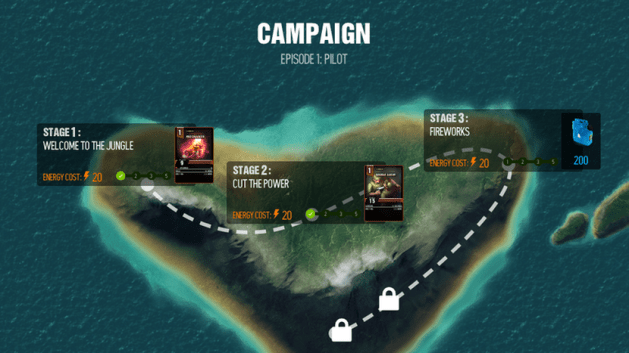
Due to level reusage, each of these islands sported a generous mixture of the following: a drug lord’s villa, a south-american slum, a mayan temple, a crashed Air Force One or a military base (I might be forgetting something here). What’s more, they all are identical across the different islands.
All in all, this ended up feeling like a lazy excuse for an overworld screen. I believe a solid backstory would have prevented this.
Finally, although this is more a production/marketing matter, the expected cost/reward ratio was extremely convenient. For a game trying to capitalize on the desire for new characters, not enough efforts were made on differentiating the heroes and making them memorable. No backstory meant no screen-time for new heroes, and unless they were lucky enough to open them in random packs, the players would never know those heroes even existed. Not to mention the extremely low cost of such a feature. Even a single comic-book page per chapter would have been plenty to showcase the amazing heroes and their personality.
Compare Broforce, a game with the same action-movie-parody premise and with little to no backstory as well. In that game, mission selection is done via a helicopter trip in the overworld, and each mission is introduced by a single, smartly-written dialogue line by a stereotyped movie general. Although these introductions have little to no relevance to the game and its story, they are funny and something to look forward to, and to be skipped on subsequent runs.
A few words on the Technical Side
All in all, The Collectables was quite an impressive technical achievement.In true Crytek style, it featured some of the best graphics ever seen on iOS.
Truth be told, some games such as Infinity Blade were on the same level if not better, but did so with very few models, directed paths and heavily scripted camera shots. All in all, they were little more than interactive movies.
The game has been developed with maniacal attention to the technical specifics, and had three different graphic tiers designed to accomodate for the different devices. Performance on slower systems was one of the main concerns and we ran stress tests regularly to make sure framerates were kept over a set threshold.
When Apple developed “Metal”, a new technology designed to improve game graphics on mobile platforms, The Collectables was one of the game showcased at the press conference:
Gameplay-wise, the game had a very clever pathing system, which was able to route a large amount of units at the same time across the whole level with no lag.
Animations tied nicely into unit movement, and the characters were able to shoot enemies while moving in a different direction or retreating.
Conclusions
The Collectables was a well executed, interesting concept with some shortcomings. The game clearly suffered from a long and drawn-out development cycle, with a few early concepts overstaying their welcome and still showing up in the latest builds.
Some decisions were made to favor monetization over gameplay, which created more problems than it solved. The lack of both an overarching story and an engaging premise made it even harder to find clear directions for gameplay.
A gameplay which, besides those difficulties, was quite engaging and fun in its core concept. Having so many moving parts facilitated emergent gameplay and gave the game surprising depth.
 Francesco Falcone - Game Design Portfolio